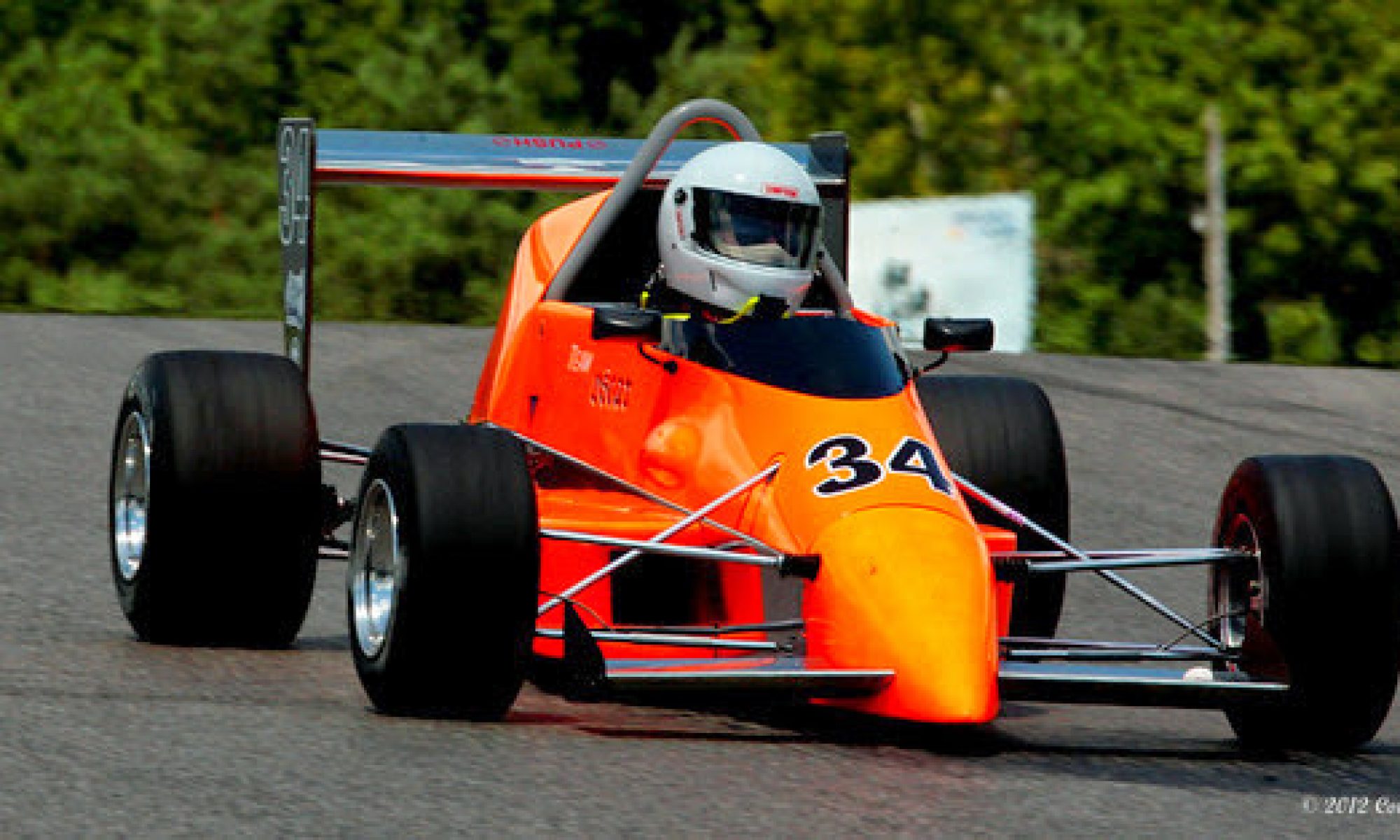

History of Formula 4 in Canada
Formula 4 (F4) in Canada is a story of ingenuity, speed, and a “built-not-bought” spirit. For over half a century, the Three Quarter (3/4) Litre Association (TQLA) has provided a home for racers who combine high-performance engineering with the heart of grassroots racing.
1967: The Arrival
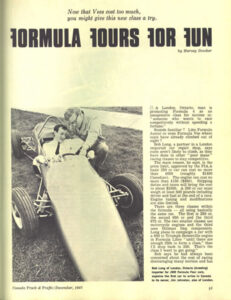
The story began in January 1967, when Bob Long of London, Ontario, traveled to Europe in search of an open-wheel car that could be raced inexpensively. He discovered Formula 4 and realized it was the perfect “poor man’s” racing class for novices who wanted to race competitively without spending a fortune.
In June 1967, the first F4 car competed in Canada at Harewood Acres, Ontario. It was a Walker imported by Bob from Johnny Walker Racing in England. Driven by Jim Johnston, this pioneer machine initially arrived with a 250 cc Suzuki engine. It quickly became clear on the sweeping Canadian circuits that the 250 cc motor was underpowered. Following that first appearance, the engine was swapped for a 650 cc unit, which became the standard for F4 in Canada.
The Triumph Era and Early Imports
During this transition, the Triumph Bonneville 650 cc engine became the power unit of choice. Bob Long notably campaigned a Triumph-powered car in Formula Libre to prove the concept’s viability. Alongside the Walkers, other English chassis like the Vixen F4 began appearing on grids. These early cars turned lap times roughly equivalent to a Formula Vee.
The 1970s: Growth and Formalization
The 1970s saw the class transition into a pillar of Canadian club racing:
- 1970: The Shift to 750 cc: Engine specs increased to a 750 cc limit to take advantage of the superior reliability and supply of Japanese engines like the Honda CB750, the Suzuki GT750 (“Water-Buffalo”), and the Suzuki GS750.
- 1974: Official Incorporation: The Three Quarter (3/4) Litre Association was formally incorporated. Key figures Robert (Bob) Long, Richard Walker, Peter Hanes, and Gord Green led the effort to have the association officially recognized by the CASC as the governing body for F4 in Canada.
A Tradition of Canadian Ingenuity: Xpit and P&G
The class became a showcase for Canadian engineering, led by two iconic homegrown chassis:
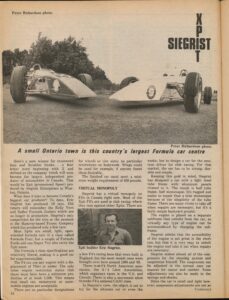
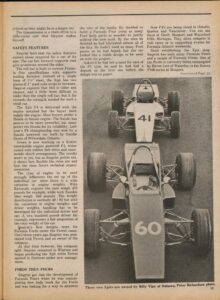
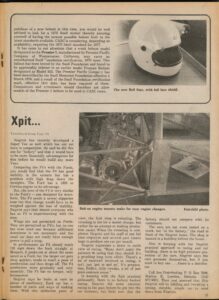
- The Xpit: Produced by Eric Siegrist (formerly of Ferret Industries) and Stu Lamont in Wiarton, Ontario. They developed a rugged tube-and-panel chassis that dominated the mid-70s.
- Gord Green and the P&G: A veteran of the “Canada Class,” Gord Green transitioned to F4 and established himself as a premier driver and builder. His P&G chassis were constant fixtures at the top of the podium.
Chassis Evolution
While production of the Xpit and P&G chassis ceased in the early 1980s, the cars continued to evolve. Owners modernized these legacy chassis with upgraded bodywork, wings, and advanced suspension geometries. This era also saw independent “one-off” chassis builds, such as the Sarabi, and the conversion of established Formula Ford and F2000 chassis (like Swifts and Van Diemens) to F4 specifications.
In the early-to-mid 1990s, the RM (Rapid Mover) chassis appeared. Only one RM F4 car was ever built. A second RM was built as an FC (Formula Continental) car; it was fitted with an 850 cc Suzuki (later 1000 cc) and, under Jeremy Hill, helped spark the creation of the F1000 (FB) class in the SCCA
The Multi-Valve Revolution 1980s
Performance reached a new level with the arrival of next-generation multi-valve (4- or 5-valve) motorcycle engines. When paired with mechanical fuel injection on methanol, the class saw a massive jump in power and speed. Legacy chassis like Xpits and P&Gs saw their older SOHC motors replaced with high-revving DOHC powerplants, including the Kawasaki ZX-7, the Yamaha FZR750 Genesis, and advanced Suzuki units.
The Original Gamma Chassis
Innovation took a leap forward with the development of the original Gamma. This was a highly specialized, narrow-body chassis featuring an innovative inboard front suspension. Only two of these original Gammas were ever built: Bob Long’s (Kawasaki ZX-750 powered) and Jim Morton’s (Yamaha YZF-750 powered).
Modern Era: E.F.I. and Gamma II
The Gamma II: A Technical Masterpiece
The pinnacle of the class arrived with the Gamma II. This chassis represented a radical departure in engineering, featuring:
- Full inboard suspension with inboard shocks.
- Invisible (virtual) pivot front suspension and steering.
- Advanced Aerodynamics: Lightweight carbon fiber bodywork and a full undertray/diffuser for ground effects.
- The Arrival of EFI: The Gamma II was the first F4 to feature the Suzuki GSX-R750 with Electronic Fuel Injection, bringing modern computer-controlled precision to the track.
- Yoshimura Competition ECU/EMS
- Power Commander Autotune
- Hindle headers and exhaust
Today, a Gamma II is a formidable racing machine. At Canadian Tire Motorsport Park (Mosport), these cars turn lap times in the 1:22s—comparable to an F2000. It is a massive evolution from the early Triumph-powered cars, proving that the TQLA remains at the cutting edge of Canadian club racing.
The original spirit of F4 continues today under the stewardship of F4 Canada (Three Quarter Litre Association.) Racing as part of the CASC-OR Road Racing Series, F4 Canada competes at legendary tracks including Mosport, Shannonville, and Calabogie. We remain the ultimate “built-not-bought” class, combining professional-level speeds with the heart of grassroots racing.